29 JANUARY 2026
29 JANUARY 2026
Author of the article

JUNIOR ASSOCIATE
PARTNER
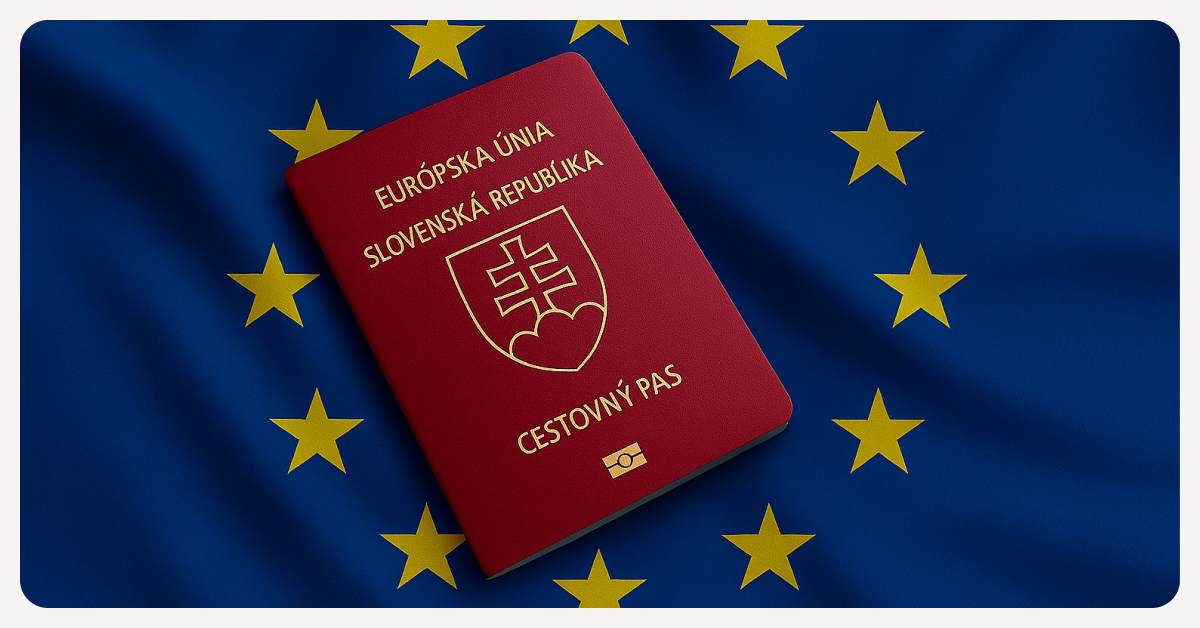
The Act on Slovak Citizenship [1] and the procedures for acquiring citizenship have undergone several changes in recent years. Its current wording significantly simplifies and broadens the possibilities for acquiring Slovak citizenship compared to the past.
For Slovaks living abroad, there are primarily 3 main ways to acquire citizenship.
The first concerns Slovaks
living abroad who already hold a certificate of a Slovak living abroad or who
are interested in obtaining one.
This is a special group for whom
the law creates more favorable conditions to acquire Slovak citizenship. It
concerns persons of Slovak origin who maintain Slovak national awareness, and
it is sufficient to demonstrate Slovak roots in the direct line of descent,
without restriction to a specific number of generations. It is not required
that the ancestors were explicitly citizens of the Slovak Republic – their
Slovak nationality is decisive. This procedure allows individuals with deeper
family roots in Slovakia to acquire citizenship. If a Slovak living abroad does
not meet the requirement of three years’ residence in the territory of
Slovakia, they must demonstrate their contribution to the community of Slovaks
living abroad. [2]
The second concerns descendants
of Slovak or Czechoslovak citizens (parents, grandparents, great-grandparents)
who were never citizens of the Slovak Republic.
These persons can acquire Slovak
citizenship if their ancestor was born in the territory of the Slovak Republic
(Citizenship by Descent). [3]
The third concerns former
citizens of the Slovak Republic who lost their Slovak citizenship in the past.
These persons, upon meeting legal
conditions, may regain it. This option is particularly significant for
individuals who lost Slovak citizenship due to the previous legal framework in
effect from 2010 to 2022, when acquiring foreign citizenship automatically
resulted in the loss of Slovak citizenship. The current legislation thus opens
the way for these individuals to regain Slovak citizenship and restore full
legal relations with the Slovak Republic. [4]
An interesting point is that in
some cases citizenship may have arisen automatically at birth but was never
administratively confirmed. This applies, for example, if at least one
parent was a citizen of the Slovak Republic at the time of the child’s birth,
but administrative confirmation of citizenship for the child was never
processed or documented. In such situations, formal registration must be
arranged, which does not constitute a “new” grant of citizenship, but rather
its subsequent confirmation.
Acquiring citizenship of the Slovak
Republic also means obtaining European Union citizenship, which allows
one to live, work, conduct business, and settle freely in any of the 27 member
states without visas or special permits, together with family members (subject
to necessary conditions). [5]
One of the main practical
advantages is unrestricted access to the labor market across the EU. A
citizen of the Slovak Republic can work in any member state without the need
for a work permit, which significantly expands career opportunities compared to
citizens of third countries. [6]
Similarly favorable conditions apply in business, where an EU citizen can
establish companies and conduct business anywhere in the EU under the same
conditions as local entrepreneurs, including easier access to certain forms of
European business support. [7]
Another significant benefit is a strong
Slovak passport, which, according to The Henley Passport Index, is ranked
the 5th strongest passport in the world, allowing visa-free entry to 184
countries, surpassing the passports of several traditionally strong states,
such as the USA, Australia, and the United Kingdom. [8]
In the area of education, EU
citizens can study in other member states under the same conditions as local
students, which in many countries means free or substantially subsidized
higher education. [9]
Slovak citizenship also allows
access to public healthcare within Europe through the European Health
Insurance Card, ensuring access to necessary care during temporary stays in
EU countries and selected other states under the same conditions as local
insured persons. [10]
Additional advantages include the
right to vote in European Union institutions, automatic acquisition of
citizenship by children of Slovak citizens at birth, as well as entitlement to
consular protection from Slovak diplomatic missions and, if necessary, other EU
member states’ missions in countries where Slovakia has no representation.
Slovak citizenship also provides a stable and permanent legal status that can
only be revoked in exceptional cases defined by law.
The legal regime in this area has
undergone several changes in recent years.
A highly debated regulation was
introduced in 2010 based on Amendment No. 250/2010 Coll. to the Act on Slovak Citizenship.
It aimed to prevent dual
citizenship upon voluntarily acquiring foreign citizenship (this did not
apply to citizenship acquired by marriage or at birth).
The explanatory memorandum to this
amendment stated that
dual citizenship is undesirable because it creates concurrent legal ties to two
states, which may lead to serious practical issues in exercising the rights and
obligations of a citizen. It also noted that the negative consequences of dual
citizenship are even more pronounced when it is not a matter of isolated cases,
but rather the mass granting of foreign citizenship.
However, this barrier was
removed in 2022 by Amendment No. 72/2022 Coll., which allowed, under certain conditions,
retaining Slovak citizenship even when acquiring foreign citizenship. [11]
Those who lost their citizenship
due to the 2010 amendment did not automatically regain it, but the 2022
amendment enabled them to apply for citizenship without needing to have
residence in Slovakia. [12]
The 2022 amendment also introduced
another significant change – expanding the possibilities of acquiring Slovak
citizenship for persons of Slovak origin. For descendants of Czechoslovak
citizens, the law now allows them to acquire Slovak citizenship without the
requirement of continuous permanent residence in the territory of the Slovak
Republic, provided they can demonstrate that their ancestor (parent,
grandparent, or great-grandparent) was a Czechoslovak citizen born in the
territory of present-day Slovakia. [13]
Before this amendment, descendants
had to meet more stringent requirements. To acquire citizenship, it was
necessary that “one of their parents was a Czechoslovak citizen at the time
of their birth and the other a foreigner, and according to §1(2) of Act No.
194/1949 Coll. on the Acquisition and Loss of Czechoslovak Citizenship, the
Czechoslovak parent did not request the express consent of the regional
national committee for acquiring Czechoslovak citizenship, and resided
continuously in the territory of the Slovak Republic for at least two years
immediately preceding the application for Slovak citizenship.“ [14]
The amendment further simplified the acquisition of Slovak citizenship for persons with the status of Slovaks living abroad. These individuals no longer always have to meet the previous three-year residence requirement in Slovakia if they can demonstrate their contribution to the community of Slovaks living abroad. [15]
[1] Act No. 40/1993 Coll. on the Citizenship of the Slovak
Republic (“Act on Slovak Citizenship”).
[2] Sec. 7(3) of the Act on Slovak Citizenship in connection
with Act No. 474/2005
Coll. on Slovaks Living Abroad.
[3] Sec. 7(2)(j) of the Act on Slovak Citizenship.
[4] Sec. 7(7) of the Act on Slovak Citizenship.
[6] Source: https://employment-social-affairs.ec.europa.eu/policies-and-activities/moving-working-europe_sk
[7] Source: https://european-union.europa.eu/live-work-study/doing-business-eu_sk
[8] Source: https://www.henleyglobal.com/passport-index/ranking
[9] Sources: https://europa.eu/youreurope/citizens/education/university/fees-and-financial-help/; https://www.study.eu/article/study-in-europe-for-free-or-low-tuition-fees
[10] Source: https://employment-social-affairs.ec.europa.eu/policies-and-activities/moving-working-europe/eu-social-security-coordination/european-health-insurance-card_sk
[11] Sec. 9(18) of the Act on Slovak Citizenship.
[12] Sec. 7(7) of the Act on Slovak Citizenship.
[13] Sec. 7(2)(j) of the Act on Slovak Citizenship.
[14] Sec. 7(2)(j) of the Act on Slovak Citizenship effective
before Amendment No. 72/2022 Coll.
[15] Sec. 7(3) of the Act on Slovak Citizenship.
Share the article

PPA contracts connect renewable energy producers with consumers, ensure price stability, and the on-site PPA model can fundamentally transform electricity supply for businesses in Slovakia.
15 MAY 2026
The end of 2025 in the energy sector was marked by major legislative changes. The key document was the amendment to Act No. 251/2012 Coll. on Energy (published as Act No. 259/2025 Coll.).
5 FEBRUARY 2026
Courts are increasingly ruling on lawsuits, by which the citizens seek to take an active approach to climate change mitigation.
29 JUNE 2021